Showing posts with label Thailand. Show all posts

Friday, 23 October 2015

Spirit at Rest

by John Keeble

A monk is sitting in an old plastic chair in the bedroom next to mine. He is chanting, low and hardly a change in tone. On the floor, in front of him and at the foot of the bed, there are four figures - the house owner, her brother-in-law, her sister who has never been the same since the tsunami tore her 12-year-old daughter from her grip, and me. We sit, our legs and feet folded behind, our hands together in Buddhist prayer.

We are mourning a young Finn and helping his spirit on its way in a land crowded with tragic spirits from the 2004 tsunami. Three hours earlier we had watched him die, his face almost purple with some kind of seizure, his strong young body straining and his bloodless white hands gripping the air like claws.

The owner and her sister were raising the alarm as I returned. He was on his back on the bed, looking very ill, and his bag was half packed on the floor - he had been found because he had not checked out for his flight home.

As we waited, watching him, watching for help, he gave one last strained spasm and just stopped breathing.

The rest of the owner's family started to arrive, then a Scottish tourist doctor, trailing her teenage daughter, who felt for his pulse and said quietly to her daughter, by then being pushed out of the door: "He's dying." They made their escape.

Every minute, more people came, crowding the first-floor outside walkway to the three rooms. We all kept looking in at him, as if he would move, and I followed the repeated descriptions in Thai supplemented with grimaces and expressive hands, nodding my agreement.

Then the paramedics arrived, bringing their yellow trolley in expectation of a dash to hospital, but they could do nothing. A little later the hospital team arrived in their ambulance, sparkling white uniforms and an urgent air of efficiency, but he was long dead, maybe half a hour.


A policeman came next, examining the body and talking to the witnesses. A Scandinavian tour rep arrived, phoned in his report, talked briefly to one of the paramedics and to me about the dead man. He went away so upset that he had to have a look at the house for sale opposite …

Another family member and his lovely little spaniel joined the throng and the spaniel caused a panic by running off the walkway and on to a roof and then on to a nylon awning, all of us expecting him to crash through, but he made it back.

Six more police arrived, led by a clever type with scene-of-incident equipment and a standard revolver on his hip. We all took it in turns to peer in to see what they were doing... A little later, his No 2 emerged for a friendly chat with the family... he wanted to know where I was from and the family beat me to telling him. Then he asked my age, squeezing my arm investigatively and saying something that drew nods of approval.


More distant family were squeezing in and a neighbour, European or something similar, came for his five minutes and left... a small knot watched from over the road, making the most of the manicured house-for-sale lawn.

Then, gradually, the crowd thinned. One of the sisters said something - it was in Thai but it sounded, in tone, just like "I can't do anything here, so I might as well go" and a few minutes later she rode off, side-saddle, on the back of her husband's motorcycle.

Eventually, there were just a few of us and we began to melt away, the owner to seek help from the monks and me to my room, a few pages of The Nation, the English-language political paper of Thailand, in the luxury of the fan.

But then the owner's sister, a kindly woman, raked me out for the monk's service. He sprinkled holy water on the deathbed, and splashed it round the door before the final service in the room. On the corner of the bed, nearest to the monk, was a cheap plastic lighter that had belonged to the dead man... a possession that linked the living and the dead.

When the monk had finished, the young man's spirit was at rest and the bad luck had been purged from the room and the building.

"I think he would like to die here," said the owner.


First published in VISA 80 (Aug 2008)

Friday, 2 October 2015

Local Life, Local Death

by John Keeble

You know what life’s like. One day, you have everything under control. The next, you have a tiger by the tail.

This was different. I had the tiger by the head. Or, more accurately, his head was in my lap and a monk was telling me: “That’s right. Stroke him. Let him know you will not hurt him.”
This was not the usual stopover in Bangkok: it was altogether more fascinating and exciting - and available just a couple of hours west of the city.

John, an Abbot and a Tiger
The visit to the tiger rescue centre at a forest monastery was part of a few days that took in the dark tragedies of the past and the rich life of today along the River Kwai and the Death Railway route where 99,044 of the 254,711 servicemen and Asian labourers died.

June and I, en route to Australia, flew into the City of Angels and checked into the Grand China Princess, a friendly hubbub of a skyscraper hotel on the edge of Chinatown. It has a fabulous revolving restaurant - Japanese cuisine, good vegetarian selection - on the top floor. And a double room at £22 a night makes it a bargain.

Normally, we would use public transport in Thailand but we arrived in Bangkok tired from the previous few months and chose a luxury option...staying on a raft on the River Kwai with the service including a pick-up from the China Princess.

So, at 6.00 am the next day, we were on the road to Kanchanaburi on Thailand’s western border with Burma (aka Myanmar)...by midday, we were doing a quick round of the Bridge Over The River Kwai sites - the Don Rak war cemetery in the middle of town, the museum next to it and the bridge itself. For some people that would be long enough but, for us, it was just a recce for our planned return after a few days R&R on the raft.

By early afternoon we were on a longtail boat gliding up the River Kwai - stunningly beautiful in its moods from dawn mists to the deep hues of sunset - and into the mountains and jungles until we reached the River Kwai Jungle Rafts.

The rafts - with their cabins, open-air restaurant and even a small folk theatre - stretched into the arc of a river bend, the jungle tangle above them hiding a Mon settlement that staffs and runs the services available. The trailing flowers glowed, the welcoming smiles invited us on board and the sparkle of the river spoke a language of tranquillity.

We spent three nights and four days based there, fascinated by the mists and colours of the river, the riverbanks and the people - and, after so much planning, ending up at Tiger Temple, the Wat Pa Luangta Bua Yannasampanno, famous worldwide for its rescue work... “The monastery is not only for man, but for all animals who seek the peacefulness.”

This is where the monks take in tigers, some orphaned by hunters, some rescued from people abusing them. They calm the cats and, with kindness, get them to accept people. They hope that the new generation of tigers - offspring of the rescue tigers - can be trained for the wild to help stem the loss of the IndoChinese tiger population - but the rescue tigers will never be able to go back to the wild.

Pai, our Mon guide who had organised the transport, dropped us off at the monastery entrance with an arrangement for him to return for us later and we made our way into the grounds.

Although the land was given for the purpose of building a wat, and a Buddhist abbot and his temple donated millions of bahts towards the project, there is a high cost of feeding and caring for the tigers - plus hundreds of other animals that use the monastery’s 275 acres as a welcome sanctuary. The monks have come up with an answer: they welcome visitors and the money raised, including 300 bahts (about £4) entrance fee, feeds the animals. Guess which nationalities top the list of visitors; Britons and Aussies.

We wandered through the grounds, found the temple and there met Phra Acharn Sam, a monk who helps with the temple and the tigers. He was having his last meal of the day with some novices and he pointed us in the right direction to meet the Abbot, Phra Acharn Phusit.

When the Abbot came, he was not alone. He had a fully-grown tiger walking by his side like a well-trained dog. A dozen tourists were waiting, too, so the meeting was not exactly what we had expected.

The Abbot slipped a chain on the tiger, left him lightly secured to a tree like you might leave your dog for five minutes outside the newsagents, and supervised the local village helpers letting out the four three-month-old cubs and getting ready most of the other tigers for their exercise.

While everything was being prepared, the cubs did their best to get into any kind of mischief they could.

As Abbot Phusam and others walked off with the tigers towards Tiger Canyon, he invited visitors to walk with him and his tiger one at a time. A helper took photos with visitors’ cameras.

Fifteen minutes later, this strange procession arrived in Tiger Canyon and the tigers were given their favourite places to lounge in the sun; Abbot Phusam talked to them; the visitors waited, amazed at being close to the tigers and seeing the monks and helpers even closer.
Then came the surprise for almost everyone. If anyone wanted to get up close and personal with these eight grown tigers, they could - for no more than a small donation to the fund for the tigers’ food and a little kindness to the tigers.

And, one by one, we were introduced to the lounging tigers and the village helpers used our own cameras with considerable skill to capture these priceless encounters... incredible moments of contact with creatures whose image is one of a terrible hunter.

Unfortunately, it is the tiger that is the hunted to extinction and the stories of cruelty to tigers are awful. Their numbers are dropping throughout South East Asia despite their protected species status. 

At Tiger Temple, the monks have been building a 12-acre moated island to house the cubs under training. It has a new block for the tigers when they are not roaming and, over the top, a floor to accommodate visitors and academics studying them. The facility, after years of building, is due to open later this year.


We walked round it with Phra Acharn Sam, looking down on Tiger Canyon at one end and following it round to the point where the tigers live now. By the time we got there, Abbot Phusam had led the procession back... it was time to put the tigers in their night cages.
As the light faded, the other animals came for their nightly feed - hundreds of them, especially wild boars who have made it their sanctuary after the monks nursed an injured boar back to health.

Our new friend Pai had arrived in the canyon before we were ready to leave, and he was as thrilled to meet the tigers as we were... later it was dark, long after other visitors had left, before the three of us met one of the rafts’ managers who had been despatched to collect us. It was too late to get back by river, so we joined his round of business collections and then went in the back way, down the mountain trail too steep for anything but a four-wheel-drive and a very strong nerve.

Next day came the next fascinating foray into local life and death. That stretch of border has always been a killing ground for Thais and Burmese - it is where they have fought over the centuries and, as they say, it is marked with the bones of their finest young people.
But the people of the area also honour the Second World War deaths of Allied soldiers, Asian labourers and even Japanese soldiers from the infamous Thai-Burma railway.
That day, we saw Hellfire Pass, where Allied prisoners worked around the clock to cut their way through solid rock for the railway pass. They did it by hand, chiselling and with compressor drills that one held and turned and the other hit with a hammer. The Japanese put dynamite in the drill holes and blew the rock apart.

That part of the railway started on 25 April 1943, the day the bridge over the River Kwai was completed, and the next month the devastatingly brutal “Speedo” period, where prisoners and Asian labourers were forced to work harder and longer, began. By the middle of May, the first prisoners were dying of cholera … August, the rainy season with its diseases and difficulties, was the worst month for deaths but Hellfire Pass work went on until it was finished the following month. It got its name from the flames and glow of lights at night as men worked until they dropped. And for the cruelty that left 300 men dead.
June, Pai and I walked down the old track, each sleeper said to represent a life lost, as the peaceful mist lingered in the valley below and the sun struggled through the trees. As we looked ahead at the last bend, the disused Hellfire Pass stood timelessly in view... the same shapes we had seen in the sketches made when the prisoners hacked and blasted their way through.

In the rock sides, the marks of the chisels were still there... a broken compressor drill sticks out of the rock as it was left more than 60 years ago...the plaques remembering the medical heroes who saved lives as they could... and the crosses and poppies, the blood red symbols of remembrance from another continent and another war.

By the time we had seen it all, including the black marble memorial, groups of tourists were being brought in: Australians, Thais, Europeans and Americans, Japanese, dozens of nationalities, were making their awed way through the pass.

It was not until the next day that we went on the railway. The old railway was sold to the Thai government at the end of the war and closed because of fighting in border areas. Later, part of the route was closed forever by a huge reservoir.

But, in 1957, some of the route was reopened. We joined the train for 90 minutes on the way back to Kanchanaburi, leaning out of the doors for views of the train crossing the trestle bridge and to see the River Kwai far beneath.

The coach ride back to Bangkok was something we skipped. The ever-helpful and kindly river raft people dropped us off at the River Kwai Hotel and we booked in for a couple of nights... enough time to revisit and photograph the cemeteries and the bridge.
We spent much of a day at the Don Rak war cemetery, which has nearly 7,000 graves - a spacious parade of the dead, their headstones in neat lines radiating out from the cemetery’s large cross. British, Australian, Dutch... some identified only as an Allied soldier... some as no more than a soldier of the Second World War.

They were there in moving simplicity: W J Pinckney, air gunner RAF, age 21, ‘He sleeps in a hero’s grave, the son I loved so dear’... J Buurman, Dutch infantry soldier... R G Jeffrey, the Cambridge Regiment, age 22, ‘RIP until the dawn breaks and the shadows pass away’... An Allied soldier, ‘Known Unto God’... T W Rolls, 2/3 Australian Machine Gun Battalion, age 25, ‘Ever remembered’...

As Thai cemetery staff worked on, weeding and watering, the visitors never stopped coming in to see the graves, to read the inscriptions.

Next to the cemetery is an incredibly good museum: the story of the time, the stories of the men who lived through it, the stories of the men who did not survive.
A few miles away, the famous bridge still stands - or, at least, the concrete and steel bridge still stands, looking very much like the Second World War photographs despite the many times it was bombed and the six decades since. The first bridge, made of wood for use while the other bridge was being constructed, has long gone.

On our second visit to the bridge, we arrived at dawn... a quiet time before the city came to life and we explored the structure and the surrounding area, photographing, remembering.
It is a working railway, a working bridge, but in Thai style anyone can use it as a footpath despite gaps underfoot and the risk of falls into the broad river below. As we walked it, others started going about their days - Thais using it to get from their homes to their work, an elderly serene man who just walked it, hands behind his back and going nowhere except the bridge.

The whole area is open, the riverbanks as well as the railway line, shrines alongside girls selling River Kwai books and a restaurant looking along the river and up at the steel of the bridge. Pictures of prisoners bartering for food and others starving when the worst of the times gripped them can be seen in another museum, sprawling along the riverbank and full of fascinating exhibits ranging from a Japanese wartime train - made in England - to propaganda posters and weapons. And just down the road, quiet but well-cared-for, is the Japanese cemetery. The memories were there - the Japanese lost one in 13 of their men - but the visitors, apart from us, seemed to stay away.

The victims
This information, from the museum next to Don Rak cemetery, gives the nationalities breakdown and the percentage of deaths compared with the number of men working on the railway. They show very clearly that, while the prisoners of war suffered cruelly, the Asian forced labourers had even worse conditions and higher death tolls.

Tamils and Malays, 42,000 died, 60% of those forced to work; Burmese, 40,000, 50%; British, 6,904, 20%; Javanese, 2,900, 40%; Australian, 2,802, 20%; Dutch, 2,782, 15%; Chinese 500; American, 131; Aminese (French Indochinese), 25; Japanese and Korean, 1,000.

Dry season 1942-1943 American deaths: 0, Australian deaths: 27, Dutch deaths: 136, British deaths: 255

Speedo period, 1943 American deaths: 4, Australian deaths: 148, Dutch deaths: 418, British deaths: 430

Wet season, June – October 1943 American deaths: 88, Australian deaths: 1,630, Dutch deaths: 1,303, British deaths: 4,283


First published in VISA issue 68 (Aug 2006)


Monday, 1 June 2015

Silent World


By John Keeble

My mind was at peace, a minor miracle in itself, as I looked down on mountains and rocky terrain, deserts and deep dark canyons where a careless foot could be swallowed.

Slowly, a cloud of mauve light formed on the left, covering the desert landscape and then, quite suddenly, an intense violet eruption appeared on the right, alive and electric, white in places…

I walked on, watching my bare feet, watching the wild contours and the colours which settled down, eventually, to the calmer clouds of mauve staying just ahead of each foot as I mindfully stepped through the silent world of the old monastery hall on my walking meditation.

As I became aware again of the real details of my surroundings, I knew there was one other person there, a young man sitting cross-legged, straight-backed, deep in the shadows of a recess and his anapanasati meditation.

Earlier – and later – there was no three-dimensional landscape there, no lights beyond the rainy season dusk seeping through the concrete windows… the floor was shiny smooth, only some underlying patterns from the way it was made; and the hall was light enough to see but no more. It was silent, apart from the subdued roar of the monsoon storm.

Some experiences amaze, some stun, some fascinate… and, every once in a very long time, leave you knowing and unknowing, seeing and unseeing as you struggle to come to terms with changes they bring about in yourself.

This experience, for me, was the 10-day silent meditation retreat at the International Dhamma Hermitage at Suan Mokkh, one of the most famous meditation temples in Thailand, in the south where the border of Burma is closest to the Gulf of Thailand.

It is easy to focus on the tough living conditions of the retreat – and I will, to some extent – but the deep and, hopefully, lasting effect is on the mind as the monks, nuns and lay people explain about meditation and life. Every participant seemed to have heard a different voice, had a different experience, personal to each as we slogged our way through 17-hour days as a silent community sometimes practising alone, sometimes moving together like we were possessed by aliens in an old sci-fi movie.

Suan Mokkh is an enormous monastery, with a ‘public’ part – a reception, areas of remembrance for Buddhadasa Bhikkhu and his work there, a Spiritual Theatre, and other buildings associated with a wat (temple complex), an area for nuns and a free accommodation building for travellers who need it or who will or have attended the retreat.

At one time, Suan Mokkh was unbroken over hundreds of acres including a small sacred mountain and beyond that into the quiet coconut groves … it still has that area but today a major road bisects it.

The 90 or so men and women taking part in the retreat were aged from 16 to over 60 and arrived from countries as diverse as Australia and Germany, Israel and Canada, China and Switzerland.

On the last day of the month, we were ferried the kilometre or two from the public area to the very private, and usually very quiet, international hermitage. Secluded next to that area, there is a three-month retreat centre for Thai women who will return to their communities to teach the Dhamma (the teachings of Buddha) and meditation.

The gate, never locked, closed symbolically as we were interviewed; we signed vows not to kill anything, not to speak, to eat only after dawn and before afternoon, not to even think about sex, not to read or write except for retreat material, and not to rest on luxurious beds or chairs. We gave our valuables into safe keeping and handed over our mobile phones. Each of us signed up for daily chores… I opted for sweeping the sand, with five others, in Meditation Hall 5, an open-sided sala big enough to hold maybe 200 and our meeting place. No one wanted to clean the lavatories.

We were allocated concrete ‘cells’ with concrete beds in separate male and female quadrangles, known there as dorms, and shown to them. Mandis were outside in the quadrangles for ‘showering’; and electricity was available only long enough to get up at 4am and go to bed at 9.15pm for those who struggled on that late…

Day 1: There was a bell ringing, clear and beautiful in the blackness of my mosquito-net entombed world … don’t ask for whom the bell tolls, it tolls for us and it is 4am… I grappled with the moment, not knowing which would win – tiredness or the desire to escape the monk’s life of sleeping on a thin coconut mat on a sheet of hardboard on a slab of concrete with a block of barely shaped wood for a pillow. I felt like a blancmange that had gone splat on a hard surface with hard bits sticking painfully and inconveniently out at odd angles.

I wimped off the bed, adjusted to the night, switched on the light… must be in Med Hall 5 by 4.30… “best if you don’t wear shoes, helps with your Mindfulness… don’t worry about wildlife, the snakes are gentle (we hardly ever see a cobra), scorpions and millipedes can cause pain that will make a fisherman cry but they are never fatal, the spiders are big but harmless …” OK, if you say so.

Yesterday’s people and today’s silent apparitions floated through the darkness for maybe half a kilometre to Med Hall 5 and sat, in a deep embracing silence, for our first morning reading and meditation before going to the daily yoga. Ah, yoga. It looked like just over an hour on the schedule but it felt like two days (it was a long time ago, but as I struggled to keep up I couldn’t help thinking it had been a mistake to have my spine redesigned by a tonne of falling wood and concrete).

Then, mindfully (a key word in our training), we returned to Med Hall 5 for a Dhamma talk and more sitting meditation before, finally, at 8am, it was time for breakfast of rice soup with vegetables and raw leaves of various delicious kinds plus tea.

The day, like most of the others, took its course: After breakfast, our chores. By then it was pleasantly warm (that’s a euphemism for feeling hot, sweaty, unshaven and wearing yesterday’s clothes), but a cold mandi shower and shave awaited us. Then: 10.00 Dhamma talk; 11.00 Walking meditation; 11.45 Sitting meditation; 12.30 Lunch (last meal of the day: vegetarian curry, rice, maybe noodles or vegetables, and a dessert or fresh fruit) and hot spring; 14.30 Meditation instruction and sitting meditation; 15.30 Walking meditation; 16.15 Sitting meditation; 17.00 Chanting & Loving Kindness meditation; 18.00 Tea (mug of…) and hot spring for some, but the second cold mandi shower for me; 19.30 Sitting meditation; 20.00 Group walking meditation round the ponds under a night sky of crescent moon and stars bright with no ground light pollution; 20.30 Sitting meditation; and 21.15 Bedtime. In there, during the breaks, was some rest time: most slept but for me it was a tranquil time sitting in the shade by the ponds.

Within a few days, I realised that anapanasati (the breathing technique taught by the Buddha) was not for me and I switched all my efforts to walking meditation. At first, I thought walking meditation would be easy: it just needs concentration, right? Yes, right… first, the mind is very rebellious. Then, when you cosh it into some kind of co-operation, it gets very sly… it knows all your weaknesses, all your little mental rat runs, and it does anything to tempt you from concentration on just walking. At one stage, it escaped and within 10 steps, it had planned a business … on another, it conjured up a metre-high bottle of Singha beer right in front of me and, the depth of slyness, used that to tempt me into laughing at the joke countless times afterwards.

But, by Day 7, I was getting there. Then the monsoon returned with a vengeance. And the biting ants were intent on revenge for just one little moment’s loss of mindfulness… so I moved to the oldest meditation hall, where almost immediately I experienced deeper concentration and saw three-dimensional images and colours as I meditated.

The storms got worse, the rain so fierce it was forcing itself through my umbrella. Previously dry areas were deep with water and the mud squelched pleasantly between the toes.
The retreat’s meanings got deeper too, and what seemed shallow at first now opened like a lotus flower and we began to see some of the links with life that, in respect of dukkha, have hardly changed in two and a half thousand years.


On Day 11, after the usual 4am rise, the retreat finished with a final address by the abbot, Tan Ajarn Poh. There were fewer people than when it started. Some had left, for whatever reasons, but most of us were there to hear Abbot Poh.

Back at the dorm, as we packed, cleaned up and got ready to say hello to a luxurious bed somewhere, someone was softly whistling I’m Leaving on a Jet Plane.

But I was wondering what it had all been about. Not because there was so little but quite the opposite. There was so much that I wanted to keep and use when I got back to what I was no longer sure was the real world.¦

Web: www.suanmokkh-idh.org

Location: a taxi ride from Surat Thani airport north of the city

Cost: 2000 baht when registering. Cash

Dates: Last day of each month through to the end of the 10th of the next. No email etc booking: you have to go there but can stay overnight free and you leave on the 11th

Food: All vegetarian, almost all vegan, popular with everyone

Take: Loose clothes (fisherman pants, T-shirts), toiletries, towel, flashlight, mosquito repellent

Alternative or additional Five day retreat on Ko Samui around the 15th of the month. Same people organise it. Start dates vary, so need to check. But there is far less guidance so you need to know why you are going and what to do.

First published in VISA 84 (Apr 2009)

Sunday, 12 April 2015

Signs of Recovery


by John Keeble

You would expect to feel something in Bang Niang and Khao Lak. Some atmosphere, some dreadful depression. But you don't. They're just very pleasant Thai coastal resorts, with their sprinkling of tourists eating Massaman curries and drinking Singha beer - in fact, they've been described as the 'new pearl' of the Andaman coast.

Longtail Boat
It's only in the quiet of their homes that local people still relive the horror and cry over the dead from the tsunami that killed more than 5,000 people, locals and tourists, before their stunned eyes along this resort coast on Boxing Day 2004.

Bang Niang, three kilometres north of the better-known Khao Lak, was the worst hit. Bodies, debris and even a big police launch were found a taxi ride from the beach. But for us, now, it still has the beautiful sunsets, the laid-back eateries with unbelievable quality and cheapness, the spectacular beach, the colourful market twice a week.

Today, pretty much everything is new or renovated and building is going on everywhere. You can buy a villa for three million bahts (about £46,000). Or you can pay nearly 10 times as much for the luxury of fronting the beach. And Thais and tourists - mostly Germans and Scandinavians fleeing their harsh winters - carry on the business of making money and enjoying life.

You don't understand until you have seen the pictures and talked to the survivors. But, oddly, the enjoyment of the area is still there and, because you are helping the people rebuild their lives, there is no guilt. In fact, there is a satisfaction, a feeling of alleviating, in some small way, the people's suffering... without the tourist income, their communities wouldn't survive; and without tourists enjoying themselves, there could be little hope for the future.

Of course, there are the tsunami signs now, strikingly blue and white saying what to do in the event of a tsunami warning signalled by the new siren system. They weren't there when the great tsunami swept in after an earthquake under the sea off Indonesia.

One night, I bought mango and melon as I strolled among the locals and tourists in Bang Niang... it was just another market for many of us. But not for anyone who had been there after the tsunami, whose relatives and friends had been killed. The nightmare of hundreds of plastic bundles, glowing white, must haunt anyone who saw them ... those images are still on sale in a book of tsunami photographs, reprinted over and over again and the proceeds going to help the survivors.

On another day, a rumour following a quake in Indonesia led to the market being cleared in minutes and a mass flight to higher ground. That same evening, I walked down to the deserted beach... it was odd how the night before, the gentle lapping of the water had been so attractive as I dined and yet when I heard it that night the same melody sounded so menacing.

One of the first tsunami survivors I met was Bee, who runs Fairhouse, a Bang Niang complex of rooms and bungalows rented out for a fraction of the price of the big hotels. She showed me the official post-tsunami books ... and then, less dramatic but more touching, albums of her family photographs showing what life was like after the tsunami.

"I cried for three months, just asking all the time, why, why did it happen?" she said. "So many people died. My elder sister's daughter, she died, and my other sister's daughter, she died.

"People came in [to the Bang Niang and Khao Lak area] to help, to take the bodies. The market was full of bodies. So many.

"It has been very bad and some people cannot do anything but cry now. I go to see them and we talk and it makes them happy.

"After it was over, I bought a Buddha in Bangkok and now it is beside my guest home. I pray there. I have developed my middle eye of kindness and I help everyone. I do everything now: I don't know what the future will bring. I give money to orphanages in Takuapa, children whose mothers and fathers died in the tsunami, and to an orphanage in Bangkok. I get up at four and boil rice for the monk when he comes. I give to the temple.

"I don't know how long I live, when I will die, so I have to do good now, today. It gives good luck to me too. People middle eye me with kindness.

"I think there will be another tsunami but not in the next year or three years. In a hundred years or more."

Another tsunami survivor was a young man standing outside his tailoring business. He had seen me for weeks and had given up trying to sell. The night was deserted after unseasonable storms kept tourists in their hotels.

He called after me: "Hello, papa." I replied "hello" and went to walk on but he was desperate for someone, anyone, to talk to and called out: "No buy, just talk." I went back and we spent 20 minutes passing the time of night and during our conversation, after my questions, he told me he was a tsunami survivor but his baby died in the shop.

There's a quiet public remembrance of the tsunami, too, with the formal and informal memorials. The police boat, guarding members of the royal family before the tsunami, is still where it came to rest one and a half kilometres from the beach. The International Tsunami Museum is not far away.

Then there are the Blue Angel and Red Devil boats... together in contrast where the Blue Angel came to rest. The Blue Angel boat was swept along doing no damage and being in the right place to save a man and his young daughter; but the Red Devil boat smashed into houses and killed more than 100 people.
The Diamond resort hotel, what is left of it, can be seen through a tangle of green that is gradually reclaiming the site as its own. It was brand new and the staff had been drafted in from all around the hotel chain's empire - not one survived.


The beautifully designed and built memorial and the cemetery draw in the visitors, helping them understand the very human cost of the disaster... the beaches where nothing survived... the wrecked pier... the temple where a monk saved himself by climbing to the top...

But also there is testimony to the heroism of the recovery: the working textile business started by a Japanese monk for widows of the tsunami ... the children's workshop where they are taught to paint on textiles ... the boatyard where volunteers (many from the UK) rebuilt the fleet of lost longtail fishing boats before, when the work ran out, converting it into a restaurant... the orphanages that struggle on, month after month, from meagre donations and next to no help from the state... the people like Bee and all her family who have rebuilt their lives and their businesses...

Nearly 6,000 international volunteers as well as thousands of Thais helped in the recovery. Now it's your turn to help: just enjoy yourself and spend your holiday money in the local economy.

You will find you get a great return for every baht you spend.

Ten reasons to visit Khao Lak or Bang Niang:

1. The friendliness of the people and the great welcome you receive... with the new early warning systems, you are safe to enjoy a wonderfully relaxing and interesting visit

2. Five sleepy beaches, each more beautiful than the last, with some facing west for the sunset as you dine at tables on the sand

3. Superb restaurants with unforgettable meals at prices between £1 and £2 a dish [my average meal: penang curry, 80 bahts; rice, 20 bahts, fresh mango juice/shake, 60 bahts or, in the evening, Singha beer, 60 bahts - total 160 bahts, or £2.65]

4. Excellent accommodation to suit every need - from backpackers' dormitories to five-star resort hotels. In the middle, very comfortable, large rooms with en suite shower rooms costing between £8 and £12 a night, sometimes including breakfast ... choose between the busier Khao Lak, with every shop and restaurant you could need, and laid-back Bang Niang with its market, shops and beach restaurants
5. Jumping-off point for diving and snorkelling around the world class Similan and Surin marine parks; dozens of dive firms and schools to choose from


6. Thai massage ... forget the sleaze: this is real, respectable and thoroughly relaxing massage by trained people

7. Memorials and interesting places remembering the tsunami, plus the International Tsunami Museum and permanent exhibition of photographs at the Tsunami Volunteer Centre ... combine a day of seeing out-of-village sites with lunch and the beach.

8. Local waterfalls and jungle park

9. Easy distance to the fabulous Khao Sok national park and the less known Lam Ru national park

10. One hour car ride from Phuket's hot shopping and shows ... or go by bus: takes longer but it costs next to nothing and still gives you plenty of time in Phuket Town. Both Bang Nang and Khao Lak are on the transport network for all of southern Thailand and Bangkok

Best times to go: early November through to the end of May, with the peak months (driest and coolest) in January and February.

Best ways to go: fly to Phuket and get a car or bus up to Khao Lak or Bang Niang; or get a VIP bus from Bangkok's southern bus terminal to Bang Niang or Khao Lak - don't buy the bus ticket from a travel shop; if you do, you will end up on a tourist bus. You have to go to the bus terminal and buy the ticket, either taking a chance on the day or buying the ticket a day or two early (my choice). It's about 12 hours overnight, so the sleeping comfort of the VIP bus is well worth the fare of about £13.

First published in VISA 81 (Oct 2008)

Sunday, 1 March 2015

Drenched in the Jaws of Time

by John Keeble

It did not look good. There was a truckload of freelance fighters following us and we were heading into a checkpoint where an armed and determined enemy had their weapons pointing directly at us.

We slowed the truck. Our own fighters were ready in the back but we were badly outnumbered and not ready to fight: our planned targets were 15 km away, beyond the badlands where we were expecting an ambush at the orphanage.

‘What do you think?’ asked Ken, commander, Operation Clean Sweep. ‘Do we fight or do we run?’

I could feel the tension rising as I watched the enemy getting ready in their positions and, in the truck mirror, I could see our own fighters preparing for the worst.

Khao Lak
‘We’ve got to fight our way through, sir,’ I replied bleakly. ‘There’s no other way.’


Then all hell broke loose as the enemy, making use of an unmanned police barrier to slow us, opened fire. The first, predictably, were the six-year-old kids. Then their families. Then the big weapons, which just hosed us down, swamping our own puny firepower. And the water was cold, ice cold, and some of the most dangerous of the six-year-olds had red and green water.

Welcome to the Buddhist year 2554… this was Songkran, the Thai new year, and we were joining in the national water madness by driving our volunteer teachers, armed with water guns and two huge tubs of water, through our southern Thailand communities for the great good-humoured water fights that welcome in the new year. Thais go mad at this time and the Andaman coast was no exception. In the past, we have gone north from our base in Khao Lak but this year we went south to ‘play Songkran’ with the communities where our teachers work.
Our first target was Thai Muang, with a mixed population including a large number of Sino-Thais: we struck deep into their heartland around the Chinese temple, fighting a spectacular battle that ended when they gave our fighters not only a good soaking but also bags of crackers as a new year gift.

Then we went on a loop through Thai territory round a huge school and some of the kids out to get us had their school T-shirts on. And finally a Moken sea people village, site of another of our schools. Some of the kids there usually live at the orphanage and came out to greet us with water… In the afternoon, the teachers’ branch office – the Lazy House bar in Khao Lak – was putting on some food for those who wanted to move into the next phase of celebrating Songkran but, alas, I couldn’t join them… I was booked on the red-eye to Chiang Mai, the Songkran madness capital of Thailand. Maybe the universe.

When I emerged from my hotel in Chiang Mai, a thousand miles north of Khao Lak, it was mid-morning the next day. Sunny. Not much noise. Not many people ready with water. Maybe I’d just get a few snaps, have a wander round, eat some khao niew mamuang (sticky rice, fresh mango, sesame seeds, sweet coconut cream)…

The first bucketful of iced water hit me within five minutes. Within 10, there wasn’t any point in bothering to dodge, within an hour there were thousands of people everywhere – on foot, in trucks, on motorcycles.

The old city is surrounded by a moat, more than a kilometre on each side of the square, and I didn’t doubt that what I was experiencing was happening along every section… in my section, just off the moat road, there were three huge live performances of pop music, gyrating girls, and elaborately sprayed water giving a new meaning to ‘rain dance’. The whole event was bizarre, happy and captivatingly infectious and I just joined in, squelching along with everyone else, conning a couple of water throwers into giving me their brimming buckets so that I could pour the water over them.

When I stopped for a few minutes in the thickest of the ‘fighting’, one of the food sellers gave me a Rambo-size watergun and suddenly I found myself as part of the family, partying with the rest as four lanes of trucks and cars, hundreds of motorbikes and streams of passers-by engaged in good-humoured running battles with us.

Then – as the heroes fought on - I made my way back towards my hotel, a soggy couple of kilometres away, an easy and happy target for everyone. But I stopped on the way, bought a tray of fried potatoes because – in what must be the best town anywhere for vegetarians and vegans – there was no street food I could eat.

And then I went into a place I know for some khao niew mamuang… really good, and hopefully before I go they will have another great favourite, sticky rice and durian.

As I write this dry in my hotel, I can hear the shrieks and fun of Songkran and I’d like to be out there with them. But it’s even madder and wetter than earlier. And tomorrow we’re doing it all again…

First published in VISA 98 (Aug 2011)

Tuesday, 6 January 2015

The Thai VegFest

by John Keeble

In the soft dawn downpour, the Chinese community in Phuket Town in southern Thailand were stirring, ready for another day of rituals and processions welcoming their gods and asking for a good year ahead. The food stalls outside the Bang Neow temple were already alive with Hokkien congregants, dressed in white, eating a purifying vegetarian breakfast - this was Day 4 of the nine-day Chinese Vegetarian Festival.

And, in the lifting gloom at the front of the temple, were the first of the ma song - the 'entranced horses' whose faces and bodies are pierced in a ritual that lets the gods enter them and take on the ills and problems of the individual and the community.

Within an hour, the temple compound was heaving with people as the blaring discordant music frightened off the evil spirits and the heavy fragrance of incense wooed the nine emperor gods.

Within two hours, the thousands-strong Chinese community was on the streets, either in the parade or lining the route - not just as observers but as eager participants when priests, ma song and mediums gave blessings and symbolic gifts as they passed. In comparison to an English town or village, where few still look to Christianity for their needs, the fervour and sheer numbers of such events are stunning.

Almost every Chinese family and business with a property on the route had put out a shrine - the bank, the size of a high street Barclays, left its junior staff glumly on duty while the smiling senior staff waited at its shrine outside; nearby, a big city centre hotel had set out a huge shrine for itself and a party of Chinese staying overnight for the procession; and along the road a tiny opticians had a modest shrine, with fruit and tea for the holy mmen and women, looked after by one little old woman.

We joined the Bang Neow congregants as dawn struggled against the monsoon gloom and were welcomed into the temple to see the rituals in three shrines deep in the crowded compound. In one, offerings of flowers, candles and incense were being made; in the next, the 'possessed' - the men and women taken by spirits - were being calmed and dressed in ritual clothes for the procession; and in the third, the Chinese heavenly rituals looked like Christian hell with the ma song having their faces and bodies pierced.

It was in the compound that two other rituals began: some of the possessed had swords and they swung them from the ground, over their shoulders and struck their backs with the blades; and others had knives and swords, the blades of which they used to scrub their bloody lips and tongues. Later, after the religious rituals in the town's temples, priests walked on hot coals and young men climbed ladders made from sharp blades. Everywhere, the people - young and old, men and women - were praising their gods and asking for good fortune in the year ahead.

Between the highlights of the festival, the temples returned to their quiet dignity with the faithful making their offerings and receiving the comfort of their religion.

The vegetarian festival first began after Chinese tin miners were impressed by a touring opera company that cured itself of "jungle fevers" in 1825. But the religious practices of that time grew with trade route influences, probably taking the face and body piercing from the Hindus of southern India.

For us, the Chinese vegetarian festival was a few days into a monsoon tour in southern Thailand - a last-minute decision when a cholera epidemic and serious flooding made our planned trip to southern Laos impossible. It was southern Thailand's wettest month and we were not expecting much. We could not have been more wrong, as we soon realised at the festival.

After quite a few good vegan/vegetarian meals, enough deafening fireworks and plenty of human blood, we left the Sinthavee hotel in the centre of Phuket Town by songthaew, but only as far as the bus terminal. In Thailand, buses are fast, frequent, cheap (perhaps 5% of the tourist taxi fare) and a fascinating cultural experience.

As we arrived at the bus station, the ticket office staff asked where we were going and hurried us along. We panted down the row of buses, got the right one just in time, watched as one of the crew grabbed our bags and stored them - and sat while the kindly crew waited for a missing boy. He returned and we were off. The bus eased us out of the town and onto the good main road north, over the short bridge that links Phuket island with the mainland, and eventually carried us into Phang Nga town. As the bus pulled into the straggling collection of private and public buildings, it did not look promising. We turned into the bus station and had an instant decision to make: get off now or stay on for Krabi. We got off. Something would turn up.

And it did. Mr Kean's Tour Company. Mr Kean was there to net new arrivals - though whether that was his real name, we could not decide. As a local Muslim, it seemed unlikely - until you take into account the centuries of foreigners who made their homes and careers in Phuket and, further north, at Takuapa. Anyway, he had a great old jalopy and a huge fund of goodwill and eagerness for business. We wanted a hotel? He would show us. The first was dire even by the undemanding standards of people without a bed for the night. But the second was the Phang Nga Valley Resort - it had bungalows, set in the beautiful limestone landscape, with an open restaurant that could easily seat half the readers of VISA. Like everywhere else in the monsoon month of October, it was before the season had started and everyone was getting the place ready, polishing their acts or training.

We spent four delightful days there - without cracking a system that always delivered three dishes between us for dinner however many we ordered - amid the hilarity of language problems and general goodwill.

One evening, we enjoyed a performance that was better than an impromptu theatre production. A group of German and Austrian cyclists, bravely riding from Phuket to Penang in Malaysia, had stopped for the night. The warm rain was lancing into the lush green landscape; and one of their bikes was being repaired in town. Eight or 10 of them sat together and they ordered. 

Unfortunately, the only experienced staff member was off that night. She had left the new kids in charge. They had no English and probably had never heard German before. It is more than fair to say they did their good-humoured best, but even the laws of chance did not deliver one correct meal to one hungry cyclist. As the dishes came and went back, some started laughing, some looked disconcerted and one got angry. In the end, they took what they could get and swapped until they were happy. We left, having enjoyed our three vegan dishes.

The guide books do not get too excited about Phang Nga town. But, when we got to know it better, we thought it was great for a few days. The first treat was hiring a longtail fishing boat from one of Mr Kean's pals. He took us through the mangrove channels, by the Muslim villages on stilts, and out into Phang Nga Bay with its hundreds of amazing karst islands (including the much visited tourist spot of "James Bond Island" which was used in The Man with the Golden Gun).

True, you can get a quick trip from Phuket to Phang Nga Bay and it must be better than nothing. But a day in a longtail boat, with a local to guide you through the storms and away from the tourists, was a joy. Especially since we wanted to take lots of photographs and the boatman happily responded to "just one more" gestures that meant turning the boat and approaching again.

We went from island to island, landing at several, and on one we ate a pre-packed lunch of fried vegetable rice and fruit before being led with a flaming torch into caves where aeons of shell fish and dripping calcium had shaped it for the local tourist industry. Then, after squalls between the classic calm of almost colourless Asian seascapes, the monsoon finally caught us and we had to run for cover with the boat lurching and the rain battering our umbrellas.


The next day, we got a songthaew to Wat Tham Suwankhuha (Heaven Grotto Temple) and wandered round until we found the entrance to the wat's great caverns guarded by temple staff and a small army of gibbons. Inside the first 300ft-long cavern, eyes adjusting to the dark, we could see an enormous reclining Buddha, gold in the scanty light; above, up steps, was a shrine - and, at ground level, there were perhaps another 15 or 20 Buddha images, some incredibly beautiful, others with their beauty in their symbolism.

Then, one of the "Buddhas" moved. Except that what had looked like another image was not: it was the still form of an elderly monk sitting on a dais in front of the reclining Buddha.

He beckoned me over, indicated for me to sit before him, and he blessed me in words I felt I understood without knowing a word of the Thai he was using. He indicated for me to choose a cotton from a small basket - and tied it about my wrist. When he finished, he gave a similar blessing to my wife who - several months later - was still wearing the cotton (which I had to tie, since the monk could not risk touching a woman).

Later, I read that one of the beliefs associated with the cotton blessings was that they linked the wearer with the dead during their dreams. About that time I had dreamed, very unusually, of my late father. It was an incredibly peaceful dream, such as I cannot remember having dreamt ever before, but, alas, by the time I read about the beliefs of the cottons I could not remember if it had been before or after it was tied about my wrist.

We climbed to the upper cavern, saw the historic stone carvings, and made our way back through the main cavern - and there, waiting for us, were the gibbons. But we were ready. We had bought a bunch of bananas as we left the cavern and they swarmed all over June while I snapped happily away.

A little later, we wandered through the peaceful grounds, chancing on the place where the Abbot was having his lunch. We walked by, found a quiet spot, and sat to enjoy the tranquillity. A little later, the Abbot's cook brought us food and then some more: a delicious coconut jelly with some nutty paste running through it and the whole wrapped in banana leaf, and some peanut brittle. We tackled our unexpected gift slowly, savouring the - wham! A gibbon had crept up and launched himself from the side, grabbed two coconut jellies in a second, and sat there defying us to try to take them back. We took his photo instead.

On the fifth morning, after other days of exploring the town and the nearest waterfall park (happily, on a Sunday when a few hundred of the local people were there), we cast aside the Lonely Planet and jumped on a bus to travel cross-country with the intention of a few days walking and elephant riding at Khao Sok rainforest.

We arrived full of optimism. It was a lovely place. But the monsoon season was not the best time. The main problem - apart from the rain, which had the river outside our hut rising five feet in a night - was small but persistent: the leech. In two days before we fled, we became forever part of the ecosystem through generous donations of blood.

Oddly, in this strange wet place, we picked up the taste of the best creamy green curry we had ever tasted (and now make regularly, to the fascinated admiration of our friends).

We got a bus down the Andaman coast to a five-star resort for a couple of days of rest and luxury. Except, arriving none too clean and by bus, they were not sure they wanted to let them in. Fortunately, we had the necessary passport. Ready cash. And, because others there were straight-faced package tourists and we like the smiley Thai ways, we soon got on good terms with everyone.

 So...we stayed four days; took lots of photos of monsoon days, accepted an invitation from the girls in the kitchen to be taught how to carve vegetables (and, without our specs, glad to get out with the same number of fingers as we went in). By the time we came to leave, the desk staff had no qualms about telling us the time of the bus and getting a porter to wheel our bags out to the bus stop.

And so, as we left Phuket island, so we arrived back - but not at Phuket Town. We thought we would take a chance on Thalang, a town towards the north of the island. But the ever-kindly Thais - this time the bus crew - convinced us that it was not a good idea and dropped us off just south, by the memorial to the island's two heroines.

There was yet another monsoon downpour and again we had no hotel and no idea where to go. June stayed with the bags and I scouted round. A motorcyclist stopped and asked the familiar question: "Where you go?"

The outcome was a local truck-like bus, a series of beaches deserted during low season and finally the Kamala Resort at Kamala Beach - another delightfully friendly place where a night's rest turned into a week while we used local buses to explore the island. It is worth exploring. Besides the attractions in the guidebooks, there are many surprising and fascinating places to discover and enjoy.

For us, one was an incredibly beautiful wat - with vivid colours and exceptional decoration on the temple - and, in Phuket Town, a Sino-Portuguese house with its elderly owner proudly showing his family photographs and paintings, the furniture and glamorous lifestyle in the first decades of the 20th century.

Oh, and one other place we especially enjoyed: the hotels' china wholesaler, thanks to a new friend from the Kamala Resort who had a discount card.

Now we eat our Thai creations from Thai dishes. And dream about our monsoon times in Thailand.

First published in VISA issue 40 (spring 2001).


Wednesday, 24 December 2014

The wave

John Keeble
The final preparations were being made on Thailand's Andaman coast today (24th) for big commemoration ceremonies on the 10th anniversary of the Indian Ocean tsunami. The tsunami struck coastlines on Decemeber 26th 2004, killing about 250,000 people in coastal area from Indonesia to Africa.

Survivors, relatives of the dead and foreign volunteers who helped after the tsunami struck Thailand were arriving here to join local people to remember the tragedy. Phuket, the smaller islands, and the Krabe coastline were also hit by the waves but the death toll was lower than the Khao Lak-Bang Niang coast and the fishing village of Ban Nam Khem. The victims included the King's grandson.

In Thai fashion, the commemoration will have many physical and emotional levels: the Prime Minister and top politicians will attend the ceremony at Bang Niang, where more than 2,000 tourists and local people died, and many senior figures will be at another ceremony at Ban Nam Khem, where a similar number of Thai and Burmese people were killed. But, in contrast to the ceremonies, the events will have markets, leisure areas and even amusements for the children. Local rumours doubt that anyone except invited guests will get in but I shall try.

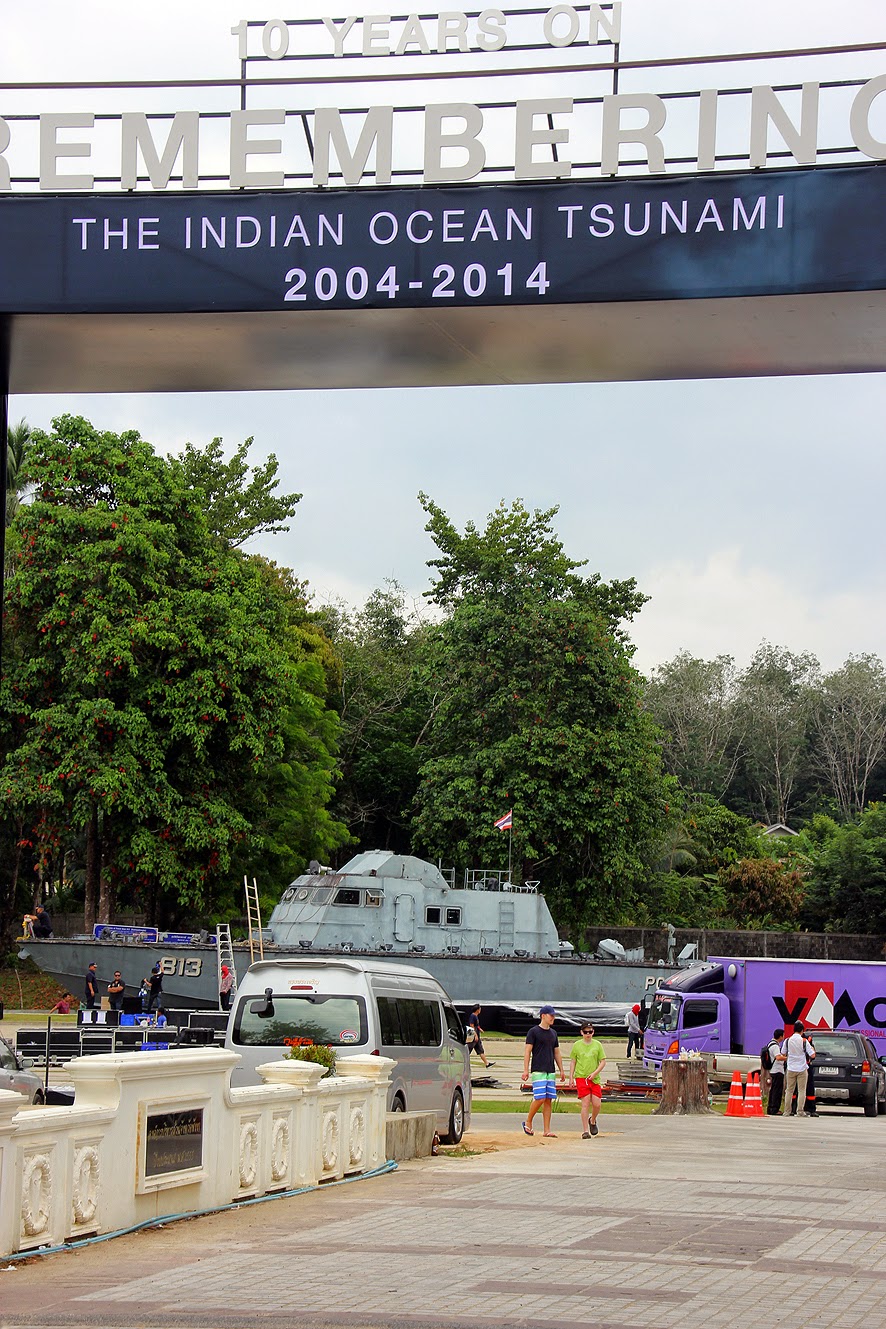
Today, I joined the emergency and building services getting ready the Bang Niang memorial -- I lived nearly opposite the site for five years but recetly it has been concreted over and extended with elaborate structures.

When I look at it, I remember the police boat that was swept more than a kilometre inland as it had been for years ... surrounded by grass, just in front of a rubber plantation.

And I think of the people, the stories, I heard when I came to Bang Niang two years after the tsunami: the wife of a man who became a friend was washed from the beach to almost her home behind where the police boat came to rest; the woman who owned the struggling resort where I first stayed told of her sister having her young daughter wrenched from her arms by the water; the tailor who suddenly told me that he had not be able to save his baby who drowned in the shop where they still lived ... there were so many stories then.

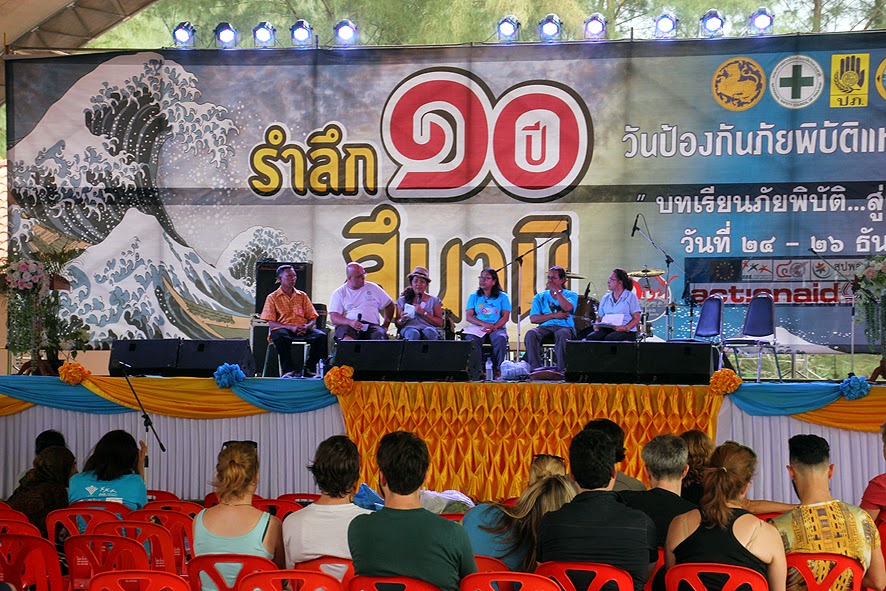
Here are some of the images from today: The memorial area in Bang Niang and the memorial park at Ban Nam Khem (where foreign volunteers held an event to talk about their experiences).